
ColorCut FB9500 Pro-T
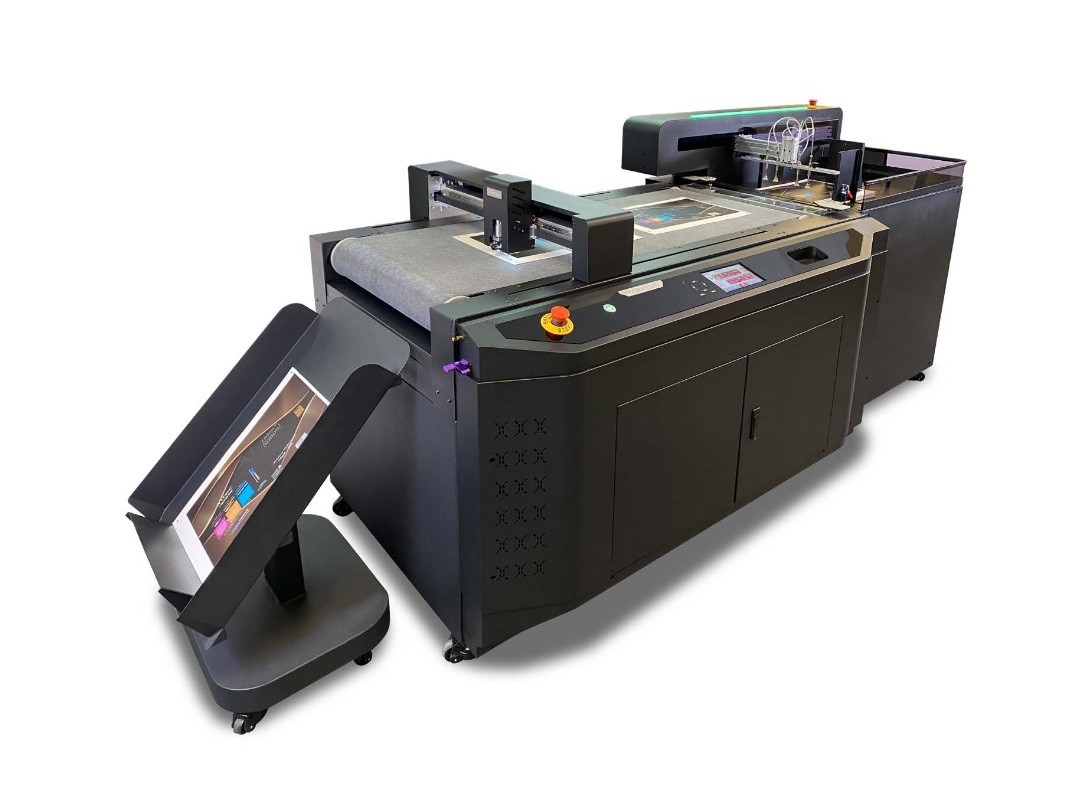
The ColorCut FB9500 Pro-T is a fully automated digital die-cutting and creasing system designed for high-volume production environments where precision, speed and flexibility matter. The machine supports sheet-fed workflows with auto-feeding capacity, QR-code driven mixed-job retrieval and a dual-tool head (cutting + tangential creasing) that easily handles varied media — from packaging and POS-graphics to labels, promotional items and rigid substrates. It offers high throughput with minimal intervention, enabling finishes that once required die-cutting tools, all via a digital workflow.
Key Specifications
Maximum sheet size (auto-feed): 500 × 720 mm (manual placement up to 550 × 850 mm)
Effective cutting area: approx. 483 × 700 mm (manual up to about 495 × 735 mm)
Maximum speed: up to 1,200 mm/sec for cutting and creasing operations
Creasing force: up to approx. 2.5 kg
Cutting force: up to approx. 1.3 kg
Media thickness range: 0.14 mm (140 µm) up to 1.0 mm (1000 µm) for many substrates
Registration / workflow: Vision CCD camera + QR code library for automated job recall
Dimensions (unpacked): approx. 3140 mm (L) × 1095 mm (D) × 1225 mm (H); weight ~531 kg
Benefits
This system allows suppliers to eliminate costly traditional dies, reduce change-over time and switch between jobs quickly thanks to its digital workflow. The dual-tool head enables cutting and creasing in one pass, which streamlines finishing of folded/creased items like packaging. The high speed, combined with auto-feed and job-library recall, supports unattended or lightly supervised operation — freeing up operator time for other tasks. Media versatility (thick boards, soft films, labels) means you can offer a broader range of finished products from one machine. Registration accuracy and automation reduce waste and improve consistency across batches.
Designer / Production Tips
When preparing artwork for the FB9500 Pro-T, ensure that cut and crease paths are clearly indicated in your vector file (e.g., different stroke colours or layers) so the dual-tool head can process accordingly. If thick board or rigid substrates are used, flag this early so correct blade, creasing wheel and parameters are set — the machine supports up to ~1 mm substrate but heavier or composite materials may require slower speeds. For mixed-job stacks (different designs on one feeder run), use the QR-code/job-library system to ensure each sheet triggers the correct tooling file. Also plan your sheet orientation and sheet size carefully given the machine’s maximum sheet size: oversized jobs may need sectioning or manual placement. Finally, although the machine can operate at very high speeds, complex fine outlines, kiss-cuts or very dense nested layouts may run better at reduced speeds for better precision and tool life.